Posts

Introduction to Modular Arithmetic, Part 1

See all posts in this series I have mentioned modular arithmetic (sometimes known as "clock arithmetic") in several of my posts. But this may not be helpful if you haven't come across this type of arithmetic before.

Using modular arithmetic to help calculate Greatest Common Divisors

In a recent FPM class we discussed how to determine \(\mathrm{GCD}(21,2^{70}+5)\). [See also my earlier post on Greatest Common Divisors ] The answer here was that \(21 \mathrel{|} 2^{70}+5\) and so \(\mathrm{GCD}(21,2^{70}+5) = 21\,.\) We discussed various ways to prove this. Some students had shown separately that \(3 \mathrel{|} 2^{70}+5\) and \(7 \mathrel{|} 2^{70}+5\), from which it follows, e.g. by prime factorization (Fundamental Theorem of Arithmetic, FTA), or by more elementary means, that \(21 \mathrel{|} 2^{70}+5\) too. In the Engagement Session we showed, instead, that \(2^{70} \equiv 2^4 = 16\)  \((\mathrm{mod}~ 21)\), which gives us \(2^{70}+5 \equiv 16+5 = 21 \equiv 0\)  \((\mathrm{mod}~ 21)\) and so \(21 \mathrel{|} 2^{70}+5\). We discovered that \(2^{70} \equiv 2^4\)  \((\mathrm{mod}~ 21)\) by looking at powers of \(2\) mod \(21\), and spotting that we had a repeating pattern with period \(6\) , so that \(2^{70}=2^{4+66} \equiv 2^4\) \((\mathrm{mod}~ 2...

The Christmas Equation

I recently posted the following on this year's FPM Piazza forum. Hi everyone, I saw this a few years ago on QI, and found another version on the web at http://mathandmultimedia.com/2014/12/02/merry-christmas-equation/ If we are told that \(y=\frac{\ln(\frac{x}m-sa)}{r^2}\)

Quantifier packaging when teaching convergence of sequences

Here is another one of my old posts, from way back in 2008. In fact I originally posted this here on Blogger, before I was persuaded to move over to WordPress. (In those days LaTeX wasn't available on Blogger. But now I can use MathJax here.) I deleted the version here on Blogger at some point, but now I have come full circle! I still think that the notion of absorption (and similar "quantifier packaging" ideas) could be very helpful to at least some students! But, as far as I know, the notion hasn't really really caught on, and I only have anecdotal evidence supporting my approach. See the WordPress post for comments on this idea from, among others, Professor Sir Tim Gowers. I'm repeating the post here mostly because the maths looks better here now using MathJax (though this particular example isn't a fair comparison, since the version of this post on WordPress doesn't actually use LaTeX). But also, it would be great if ...

FPM quiz question on permutations

Image
Here is another question and (partial) answer from my FPM Piazza forum last autumn, this time related to the "challenge question" from my First quiz on permutations . First, here is a screenshot of the relevant quiz question. (You can click on the image to view it full size.) Challenge question from first FPM quiz on permutations

Cartesian squares and ordered pairs

Here is another question and answer from my FPM Piazza forum last autumn. Question: Suppose that \(S\) is a set with two elements, say \(S=\{a,b\}\). When looking at elements of the Cartesian square \(S \times S\), are \((a,b)\) and \((b,a)\) the same element, or are they different elements? Does \(S \times S\) have four different elements, or only three? My answer: Hi, The key term in the definition of Cartesian squares, and generally Cartesian products, is "ordered pair". When you use standard round brackets in this way, the order does matter. You have specified a first coordinate and a second coordinate. For example, if you work in \(\mathbb{R} \times \mathbb{R} = \mathbb{R}^2\), the point \((1,0)\) (which lies on the x-axis) is different from the point \((0,1)\) (on the y-axis). Many of the sets \(S\) we have looked at are subsets of \(\mathbb{R}\), and this results in \(S \times S\) being a subset of \(\mathbb{R}^2\). When this happens, you can often th...

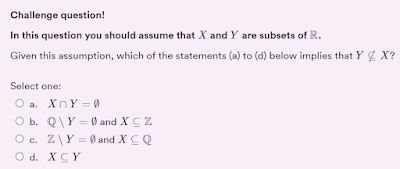
Challenge questions from FPM quizzes: First quiz on sets and subsets

Image
 My fourth FPM quiz last autumn was on sets and subsets. Again the "challenge" question isn't too hard, as long as you understand the basic concepts and definitions, though it is easy to make mistakes. Here is a screenshot of the question. As usual, the buttons don't do anything, but you can enlarge the image by clicking on it. Click on the screenshot to enlarge the image Here \(\mathbb{R}\), \(\mathbb{Q}\) and \(\mathbb{Z}\) have their usual meanings, and \(\emptyset\) is the empty set. You also need to know about the operations of intersection (denoted by \(\cap\)) and set difference (denoted by a backslash, \(\setminus\)) and the "subset" relation (denoted by \(\subseteq\)). Here I use the "subset or equals" notation \(\subseteq\) to make it clear that sets which are equal do count as subsets of each other. In particular, note that the notation \(Y \nsubseteq X\) means that \(Y\) is not a subset of \(X\), which is equivalent to saying tha...